Users Bidirectional Synchronization
Important
This is an enterprise version feature that is not included in XiVO and is not freely available. To enable it, please contact XiVO team.
Overview
The LDAP Bidirectional Synchronization module enables automatic integration between an enterprise LDAP directory (such as Microsoft Active Directory or any compatible LDAP service) and XiVO.
Its purpose is to simplify user administration, automatically provision telephony resources, and synchronize user information based on data already maintained within the company’s information system.
Through this mechanism, the LDAP directory becomes a trusted source used to create, update, and manage users in XiVO.
This module is particularly useful for organizations that want to:
centralize user management
avoid duplicate data entry between directory services and telephony systems
automate telephony resource provisioning
ensure consistency between identity management and telephony infrastructure
streamline and industrialize user deployments
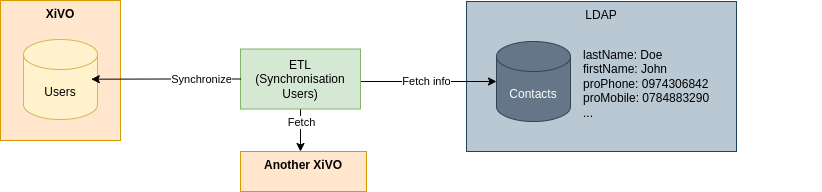
Key Features
The main objective of this module is to automatically synchronize users and associated resources between an LDAP directory and XiVO, ensuring consistent information while reducing manual administration.
This synchronization allows organizations to:
automatically create XiVO users from LDAP accounts
update user information when LDAP attributes change
remove or deactivate users based on synchronization policies
automate the assignment of telephony resources
Functional Description
The synchronization engine connects LDAP directory data with XiVO objects. The module supports:
automatic creation of new XiVO users
automatic update of existing users
removal or deactivation of users according to defined synchronization rules
This ensures XiVO remains aligned with the enterprise directory without manual intervention. During synchronization, the module can automatically manage several XiVO resources, including:
users
internal numbers (line)
Direct Inward Dialing numbers (DID)
voicemail accounts
call center agents
Depending on the LDAP attributes and configured mapping rules, XiVO can provision the necessary resources required for each user. The module supports multiple number formats, including:
internal numbering
national numbering formats
international numbering
E.164 format
This ensures numbering consistency regardless of how numbers are stored in LDAP or used within XiVO. Synchronization can allow telephony resources to be assigned directly from LDAP attributes, such as:
internal extensions
DID numbers
information related to inbound routing
This enables deeper integration between telephony infrastructure and enterprise identity management. The module can also manage Call Center agents. Based on LDAP attributes, it becomes possible to:
automatically create agents
update their information
integrate them into the call center configuration
This functionality is particularly useful for organizations operating support teams, customer service departments, or service desks. When a new user account is created, the module can automatically send a summary email containing useful information such as:
login credentials
assigned extension
onboarding or usage information
This feature requires a properly configured SMTP relay on the client side.
Functional Benefits
The main benefit of the module is the elimination of repetitive manual tasks related to user creation and maintenance within XiVO. Administrators no longer need to re-enter information that already exists in the enterprise directory. By using LDAP as the reference directory, organizations ensure stronger consistency between:
identity management systems
telephony infrastructure
user configuration
This reduces the risk of errors, omissions, or inconsistent information across systems. The onboarding process for new users becomes significantly faster thanks to automation:
account creation
telephony resource assignment
synchronization of user information
automatic delivery of login details
Users can become operational more quickly. The module is particularly valuable for organizations with:
a large number of users
multi-site environments
industrialized deployment requirements
integrated identity and telephony infrastructures
Use Cases
Enterprise user provisioning
In organizations where users are already managed in Active Directory, this module allows XiVO accounts to be created automatically without manual input.
Multi-site telephony deployments
LDAP attributes such as location, department, or role can be used to adapt XiVO provisioning according to the company’s organizational structure.
Call Center workforce management
Call Center agents can be integrated directly from LDAP, simplifying their creation and lifecycle management.
Example synchronization flow
A typical synchronization scenario works as follows:
A user is created or modified in the LDAP directory.
The synchronization engine reads the configured LDAP attributes.
Data is analyzed and transformed according to mapping rules.
XiVO checks whether the user already exists.
If the user does not exist, XiVO creates the required resources:
user account
internal numbers
DID
voicemail
Call Center agent if applicable
If the user already exists, the allowed information is updated.
If notifications are enabled, an email is sent to the user.
[User created/modified in LDAP]
             |
             v
    [LDAP attribute retrieval]
             |
             v
      [Mapping / processing]
             |
             v
      [User lookup in XiVO]
         |             |
         | exists      | not found
         v             v
  [XiVO update]    [XiVO creation]
         |             |
         +------ +-----+
                |
                v
        [Notification email]
                |
                v
         [User operational]
Pre-requisites
Ensure proper configuration of LDAP server and XiVO for bidirectional sync
Set up SMTP relay for user notification emails
Have a webservice user. The permission of this user must be : confd.#
Define which 14 information fields to include in the enriched contact sheet
Limitations
The mobile phone number cannot be synchronized from Xivo to source.
The callerid has to be mapped from a source field (it’s not possible to concatenate the firstname and the lastname).
The identifier field CANNOT be modified by a processing.
A voicemail or a line already created can’t be associated with a new or existing user. It must first be deleted by hand.
If LDAP GUID attribute must be used as identifier_field, it must mapped to description XiVO field.
Call permissions are not managed.
When en incoming call is disassiociated from its user, the LDAP attribute is not updated: a ‘None’ value cannot be pushed towards LDAP.
The outgoing_caller_id must be defined in field_mapping.yml even when it is not synchronised to avoid to overwrite with default as defined in User.py (because of LDAP update limitation against ‘None’ value).